Resisting Disappearance
Remembering in Marble

Rome remembers in marble, but not all of its dead are crowned in stone.
Beneath the church of Santa Maria della Concezione the bones of nearly 4,000 Capuchin friars have been arranged into patterns of startling precision. Femurs form archways, vertebrae ripple across ceilings and skulls are set into rosettes. The effect is neither chaotic nor grotesque: it is ordered and almost elegant.
In the Crypt of the Three Skeletons, also referred to as the Crypt of Resurrection, a child’s skeleton, believed to be that of an infant princess of the Barberini family, is mounted to the vault, a scythe in one hand and a pair of scales in the other. The bones are slight, almost delicate and around it, ribcages arc into decorative swags and vertebrae are threaded into garlands. The scene is meticulously arranged; death is not concealed here; rather, it is composed.
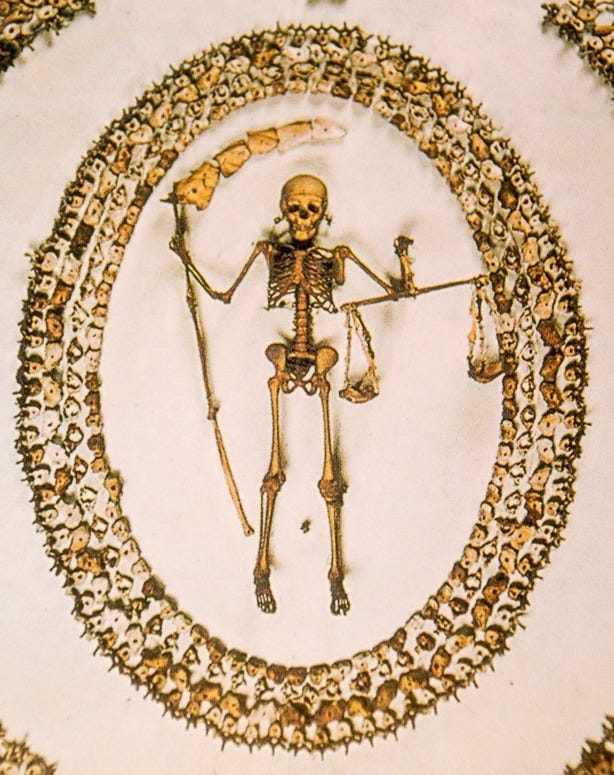
The child reads as an allegory: time and judgement suspended over the living. Yet what lingers is less symbolism than the material fact that each fragment once belonged to a body. The ossuary transforms mortality into ornament, choreographing individual remains into collective design and ensuring that anonymous lives stay in the material present.
By comparison, in the Catacombs of Domitilla, mortality withdraws from spectacle.
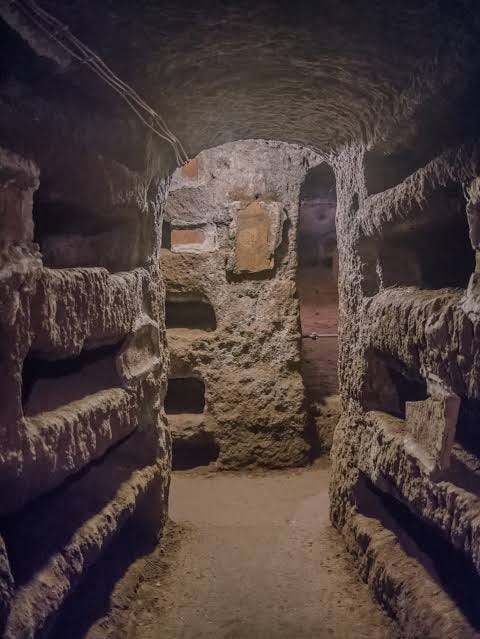
Faded frescoes surface from the dark. Embedded mica catches the torchlight, releasing a muted silver glimmer from the brown tufa; a quiet shimmer in a space otherwise hollowed in absence. In the deep, narrow tunnels humidity clings to the walls, fragments of tabellae inscriptionis are cool and damp to the touch. Mortality here is not displayed overhead but encountered by fingertips and palms.
If the ossuary insists on arrangement, the catacombs suggest continuity as an underground archive of belief rather than a curated encounter with decay. Carved loculi, large for adults, smaller ones for children, now stand as dark recesses spanning pre-Christian and early Christian burials. Fresco symbolism shifts from grapes to wine, birds to doves, gods to angels. In neither space do symbols or symmetry preserve biography. Individual identities dissolve into pattern or shadow, yet both insist that lives once occupied these forms and hollows. Both refuse erasure.
Endurance alone is not remembrance. Stone and bone persist, but they require the living to enter these spaces, to look, to touch, to interpret. Without witness, ornament is simply arrangement and hollowed tufa merely geology. Memory is not stored; it is enacted. The effect of these places is less a confrontation with one’s own death than an awareness of continuity; of participating, however briefly, in an enduring human effort to resist disappearance.